Why police departments across Michigan are moving beyond outdated command setups and how Monroe County brought their mobile command vision to life.
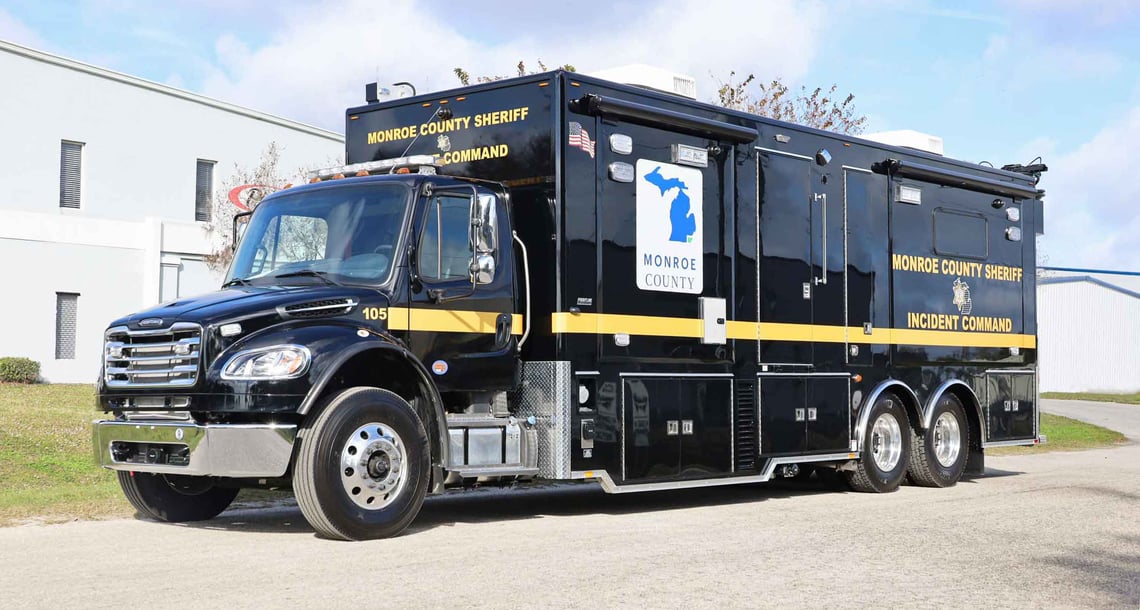
Frontline Communications recently delivered three mobile command vehicles to law enforcement agencies across Michigan — Monroe County, Eaton County and Wayne County.
In this case study, we sat down with Sheriff Troy Goodnough of Monroe County Sheriff’s Office to discuss what led to the investment of a mobile command vehicle, how his team approached the design process and what it was like working with Frontline Communications throughout the build.
This case study outlines how a law enforcement agency evaluated, designed and implemented a mobile command vehicle.
What Is a Mobile Command Vehicle and Why Do Police Departments Need One?
A mobile command vehicle is a customized vehicle designed to support incident command, communication and coordination during emergencies and large-scale events. Police departments use mobile command vehicles to improve response times and enable multi-agency collaboration in the field.
From Improvised Setups to a Critical Need for Centralized Command
 For years, Monroe County operated without a dedicated mobile command vehicle. Instead, the county’s first responder teams relied on improvised setups, working out of SUVs, tents or wherever space allowed.
“We were working out of the back of a Tahoe or under a tent,” said Sheriff Troy Goodnough. “And usually in the worst weather conditions you can imagine. Emergencies don’t happen when it’s 70 degrees and sunny.”
Over time, the limitations of these setups became more than just an inconvenience. After a series of major incidents, the need for a centralized, reliable command space became impossible to ignore.
“These incidents really pushed this forward,” Goodnough said. “At that point, it wasn’t just a conversation anymore. Having a mobile command vehicle where all of our teams can come together during an emergency became a priority.”
How Do Police Departments Choose the Right Mobile Command Vehicle Partner?
Once Monroe County decided to invest in a mobile command vehicle, the next step was to ensure they selected the right partner to design and manufacture the vehicle. Like many public agencies, the department followed a formal request for proposal (RFP) process, evaluating multiple vendors. A few defining factors ultimately led them to choose Frontline Communications.
“It came down to communication, cost and delivery,” said Goodnough. “During the bidding process, Frontline Communications was constantly following up with us, asking what they could do to help. I knew if we worked with them that communication would carry over into the design process and even after delivery. The strong communication right off the bat was a very good sign.”
The Monroe County Sheriff’s Office also conducted extensive research, visiting departments across the state and comparing different mobile command vehicles firsthand before making the final decision.
“We looked at mobile command vehicles from Frontline Communications and other vendors and how they were performing in the real world,” Goodnough said. “At the end of the day, we had complete confidence in the Frontline Communications product.”
What’s more, Frontline Communications was able to meet a delivery deadline no other vendor could commit to.
“We had a firm timeline we needed to hit,” Goodnough said. “No other vendor could commit to it, but the Frontline Communications team was confident they could deliver on that schedule.”
Read our guide to mobile command vehicles for police departments to learn how agencies are using these vehicles to improve response, coordination and community engagement.
What Should Be Included in a Mobile Command Vehicle Design?
 Monroe County worked closely with the Frontline Communications team to build a mobile command vehicle tailored to their specific operational needs.
“The whole design process was very collaborative,” said Goodnough. “There were things I threw out there, and instead of hearing ‘no,’ it was always, ‘let’s see what we can do.’ In the Monroe County Sheriff’s Office, we don’t use words like ‘no’ or ‘we can’t’—and we got that same mindset from Frontline Communications.”
Monroe County incorporated several custom features designed around how their team operates in the field. Among them:
- A dual-axle configuration to improve safety and manage vehicle weight
- A custom-built communications system, including an automated, 3-foot deployable radio repeater antenna to ensure connectivity even during statewide outages of the 800 MHZ communications system
- An electronically adjustable workstation, replacing traditional fixed or manual table setups
- A redesigned exterior work area tailored to real-world usability
The organization also integrated features specific to its geography and operations, including a marine radio system to support water-based incidents along Lake Erie’s 27 miles of shoreline.
“At the end of the day, if we brought an idea or request to the table, the Frontline Communications team worked with us to make it happen,” Goodnough said.
Looking for mobile command vehicle design ideas? Check out our recent deliveries.
A Hands-On Approach to Design and Delivery
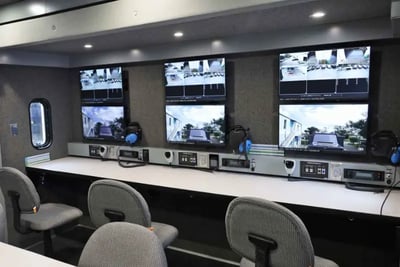
.webp?width=400&height=267&name=monroe-county-police-mobile-command-vehicle-interior%20(1).webp) As the mobile command vehicle neared completion, the Monroe County team traveled to Frontline Communications’ headquarters in Florida for a final walkthrough before delivery.
As the mobile command vehicle neared completion, the Monroe County team traveled to Frontline Communications’ headquarters in Florida for a final walkthrough before delivery.
“We brought a full team down for the final inspection,” Goodnough said. “We had IT, emergency management, fire, dispatch. We made sure to bring anyone who would be using the truck in some way.”
Rather than relying on a single decision-maker, Monroe County approached the walkthrough as a collaborative review process. Each team member evaluated the vehicle from their own perspective, ensuring the unit would function seamlessly across departments during real-world operations.
We wanted to make sure we checked every box,” Goodnough said. “Everyone focused on the details that mattered most to their role, and having all those perspectives there made a big difference.”
During the visit, the team worked closely with Frontline Communications to review the vehicle’s systems, test functionality and make final adjustments where needed.
“If something needed to be adjusted, it wasn’t a problem,” Goodnough said. “It was always, ‘okay, we’ll get it done.’ Both our team and Frontline Communications took the time to do it right, and because of that, we know exactly what we have and how it’s going to perform when we need it.”
Take a closer look at Monroe County’s new mobile command vehicle.
Extending Impact Beyond Emergency Response
While Monroe County’s mobile command vehicle was designed to support emergency response, the organization also plans to use it for community-based initiatives.
“In partnership with our health department, we’re going to take it into underserved areas and offer health checks and vaccinations,” said Goodnough. “This vehicle gives us the ability to bring those services directly to the community.”
By partnering with the local health department, Monroe County will use the mobile command vehicle to host mobile clinics and provide access to basic health services in areas that may otherwise lack convenient care. The vehicle’s interior layout also allows for private, one-on-one interactions, making it well-suited for medical evaluations and consultations.
Beyond healthcare, the organization is planning additional community engagement initiatives, including child safety programs, bicycle safety education and outreach events designed to strengthen relationships between first responders and residents.
“We want people to feel comfortable approaching us,” Goodnough said. “This vehicle will be a central hub and give us a way to connect with the community in a positive way.”
Performance in the Field and Ongoing Support
The mobile command vehicle is now fully integrated into Monroe County’s operations. Even in the short time since delivery, Goodnough has been impressed with the level of aftermarket support provided by Frontline Communications.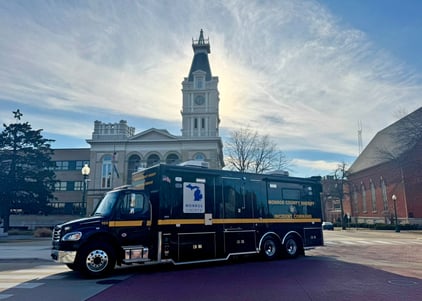
“These are highly customized vehicles with a lot of technology built in,” Goodnough said. “When we needed something adjusted, their team responded right away and sent someone out. The customer service has been top-notch.”
That level of responsiveness and aftermarket support has reinforced the organization’s confidence in both the vehicle and the team behind it. The mobile command vehicle is something the organization takes pride in.
“We took a picture of it in front of the courthouse,” he said. “It’s hanging up in our office now.”
Frontline Communications works with police agencies and other first responders across the country to design and build customized solutions based on real-world operational needs.
Contact our team to start the conversation and explore what’s possible for your department.